
Interface Aesthetics Shaping Responses to Entry Incentives Across Device-Specific Gaming Platforms
Interface aesthetics encompass visual design elements such as color schemes, layout structures, typography choices, and animation styles that define how users perceive and interact with digital environments, and these components directly influence responses to entry incentives like starter packs, trial subscriptions, and onboarding rewards across mobile, desktop, and console platforms. Researchers tracking player behavior note that aesthetic coherence between incentive presentation and overall interface design increases click-through rates on promotional offers by aligning visual cues with user expectations on specific devices.
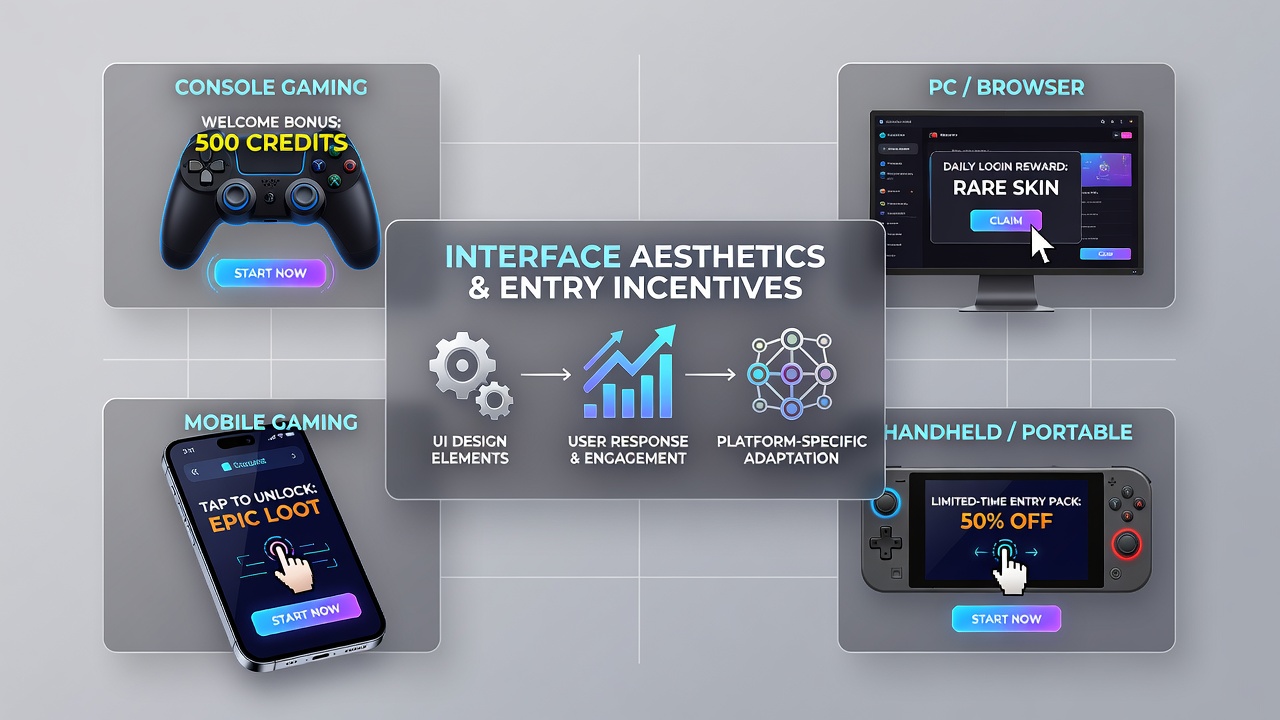
Data collected from platform analytics in early 2026 reveals distinct patterns where mobile interfaces prioritize compact, touch-friendly visuals that highlight incentives through bold icons and minimal text, whereas desktop layouts favor expansive grids that embed rewards within narrative-driven previews. Console platforms, by contrast, integrate incentives into cinematic loading sequences that leverage high-resolution textures to guide attention toward limited-time offers.
Device Variations in Aesthetic Influence
Mobile gaming platforms such as those running on iOS and Android devices feature smaller screens that demand simplified aesthetic hierarchies, and studies show users respond more readily to entry incentives when reward buttons adopt saturated colors that contrast sharply with neutral backgrounds. Desktop environments allow for layered visual storytelling where subtle gradients and hover effects draw players toward incentive panels without overwhelming primary gameplay elements, while console interfaces on systems like PlayStation and Xbox emphasize controller-mapped navigation that pairs incentive displays with ambient lighting changes.
Platform-specific constraints shape these responses further because mobile touch targets require larger tappable areas, prompting designers to enlarge incentive visuals proportionally, and this adjustment correlates with higher redemption rates according to aggregated usage logs from multiple app distribution channels. Desktop users encounter incentives framed by side panels or modal overlays that maintain visual continuity with surrounding content, reducing friction in the decision process.
Research Findings on Incentive Engagement
Analyses conducted by academic teams at institutions across North America and Europe indicate that aesthetic consistency between interface themes and incentive artwork boosts conversion metrics, particularly when seasonal palettes align with promotional imagery on console dashboards. One study released in spring 2026 examined over 500,000 user sessions and found that mismatched color temperatures between core interface elements and entry reward prompts led to measurable drops in interaction on mobile devices.
What's interesting here is how animation timing affects outcomes, because subtle particle effects around incentive icons on desktop platforms sustain attention longer than static displays, whereas rapid transitions on mobile can either accelerate selections or cause users to overlook offers depending on scroll velocity patterns observed in heatmaps. Console environments introduce additional variables through big-screen viewing distances that favor larger fonts and high-contrast borders around reward notifications.
Regional Data and Platform Trends
Figures from the Entertainment Software Association compiled through mid-2026 highlight regional differences in how aesthetics modulate incentive uptake, with North American mobile users showing stronger preferences for minimalist designs that isolate reward offers from cluttered menus. European console data, gathered through industry monitoring groups, points to preference for narrative-integrated visuals that embed incentives within story progression screens rather than separate promotional layers.
Asia-Pacific markets demonstrate elevated engagement when interfaces incorporate culturally resonant motifs into incentive displays on desktop platforms, and this pattern holds across multiple device categories according to cross-platform telemetry shared by regional trade associations. Observers note that as of June 2026, emerging hybrid devices blending mobile and console features are prompting new aesthetic experiments that test responsive layouts adapting incentive visibility based on input method.
Behavioral Patterns Across Ecosystems
Entry incentives presented through cohesive visual systems generate sustained interaction sequences where users progress from initial discovery to redemption without abrupt aesthetic shifts that might signal discontinuity. Mobile platforms often employ micro-animations that pulse reward indicators in sync with user gestures, and this synchronization correlates with improved retention metrics in longitudinal tracking studies.
Desktop configurations benefit from scalable vector graphics that preserve incentive clarity across varying window sizes, whereas console interfaces leverage depth-of-field effects to prioritize central reward elements during idle states. Researchers tracking these dynamics across ecosystems emphasize that device-specific rendering capabilities dictate the feasible complexity of aesthetic treatments applied to incentive prompts.
Conclusion
Interface aesthetics continue to serve as a primary determinant in how entry incentives register across device-specific gaming platforms, with evidence accumulating from platform telemetry and academic reviews that underscore the interplay between visual design choices and user decision pathways. Continued monitoring through 2026 and beyond will clarify how evolving hardware capabilities further refine these interactions without altering the core principle that aesthetic alignment drives measurable differences in incentive response rates.