
Device Variations and Their Effect on Promo Code Success Rates in Web Gambling Environments
Device variations play a measurable role in how promo codes perform within web gambling platforms, with success rates differing across mobile phones, tablets, and desktop computers according to interface design, input methods, and session management practices. Research from multiple jurisdictions shows that these hardware and software differences influence redemption completion, error frequency, and overall conversion from code entry to bonus activation. Data collected through July 2026 continues to highlight patterns that operators and analysts track when optimizing promotional campaigns across device types.
Core Differences Across Device Categories
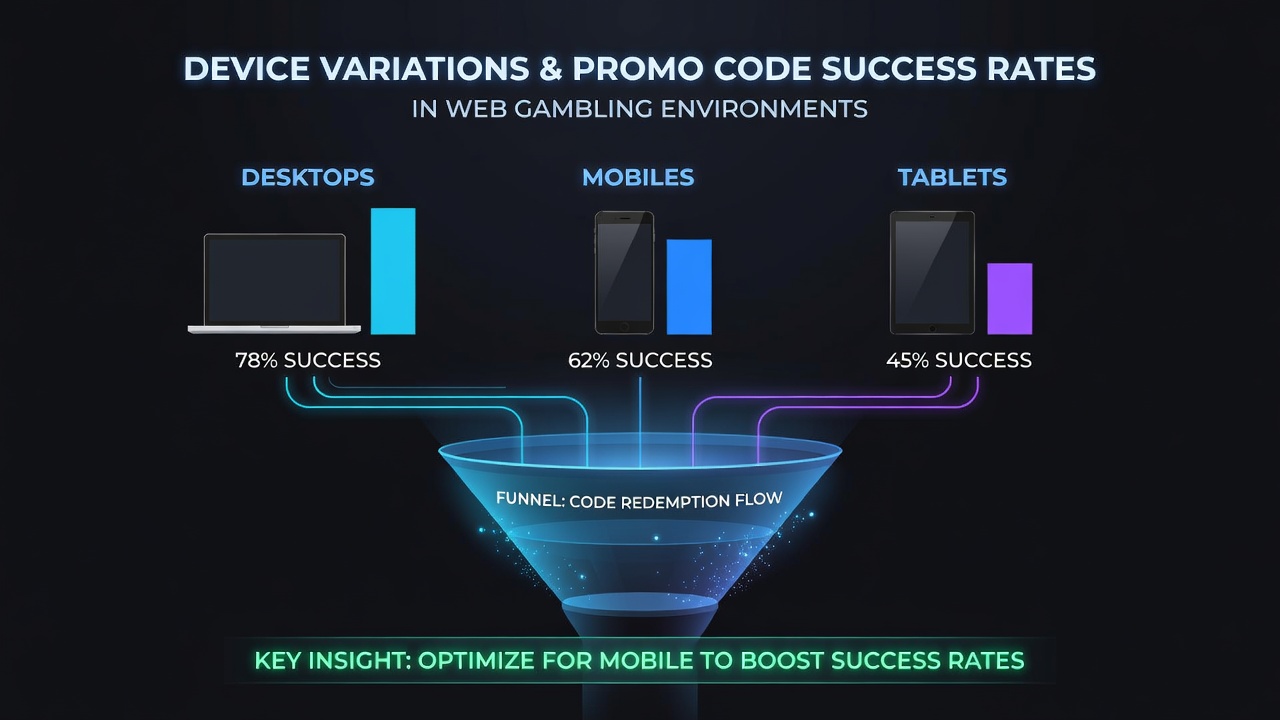
Mobile devices dominate user access to web gambling sites in most markets, yet desktop systems often record higher promo code success rates because of larger screens, physical keyboards, and more stable browser sessions. Tablets occupy a middle position where touch input combines with bigger displays, producing mixed outcomes that depend on operating system version and app wrapper usage. Industry figures reveal that mobile redemption attempts encounter more input errors during code entry, while desktop sessions benefit from easier copy-paste functions and persistent cookies that pre-fill user details.
Mobile Phone Performance Patterns
Smartphones account for the largest share of traffic yet post lower completion rates for complex promo codes because small virtual keyboards increase mistyped characters and auto-correct interference. Studies tracking user behavior note that mobile sessions frequently switch between apps, which interrupts cookie storage and forces re-authentication that can invalidate active codes. Despite these hurdles, push notifications on mobile platforms allow operators to send reminders or simplified code links that recover some lost conversions, particularly during time-limited campaigns running through summer 2026.
Desktop and Tablet Outcomes
Desktop environments deliver steadier results because users maintain longer sessions on stable connections and encounter fewer interruptions from incoming calls or battery-saving modes. Tablets show intermediate success figures, with success climbing when users employ external keyboards or landscape orientation that enlarges input fields. Observers tracking platform analytics in North American and European markets report that desktop users complete multi-step redemptions more reliably, whereas tablet performance varies sharply between iOS and Android ecosystems due to differing default browser behaviors.
Technical Factors Driving Rate Variations
Browser compatibility, operating system updates, and screen resolution directly affect how promo code fields render and validate entries. Mobile browsers sometimes strip or alter URL parameters that carry tracking data for specific codes, which reduces attribution accuracy and apparent success rates. Desktop setups preserve these parameters more consistently, allowing operators to measure true redemption numbers without the signal loss common on smaller devices. Data from regulatory filings in Nevada and reports compiled by the Canadian Gaming Association indicate that code validation failures rise when device screen widths fall below 400 pixels, a threshold crossed by many older smartphones still in circulation during 2026.
Session persistence also differs markedly. Mobile users close tabs more often, breaking the chain between code entry and account verification steps required by many platforms. Desktop sessions remain open longer, giving users time to complete two-factor authentication or upload required documents without losing their place in the redemption flow. These continuity differences compound when promotional terms include wagering requirements that must begin immediately after code activation.
Regional Data and Platform Adjustments
Regulatory environments shape how operators respond to device-driven performance gaps. Australian authorities publishing interactive gambling statistics through mid-2026 have documented higher mobile failure rates in remote regions where network latency spikes during peak evening hours. In contrast, Canadian provincial data shows desktop users responding more favorably to longer alphanumeric codes that require precise entry. Operators adjust interface elements such as code length limits, one-tap buttons, and device detection scripts to narrow these gaps, though complete parity remains elusive because hardware constraints cannot be fully engineered away.
One study released in July 2026 by an academic research group examined 12 major web gambling platforms and found that success rates on mobile averaged 12 to 18 percentage points below desktop figures for the same promotional codes. The gap narrowed when platforms deployed responsive design that enlarged input fields and disabled aggressive auto-correct features on detected mobile browsers. These technical tweaks demonstrate measurable but incomplete mitigation of device effects.
Behavioral Elements and User Adaptation
User habits further amplify hardware differences. People accessing sites via mobile during commutes or short breaks tend to abandon longer redemption sequences, whereas desktop sessions often occur during dedicated leisure periods with fewer time pressures. Researchers tracking clickstream data observe that tablet users sometimes migrate mid-session to phones or laptops, fragmenting the redemption path and lowering final activation numbers. Operators attempting to counteract these patterns introduce device-specific landing pages that simplify code entry for mobile while preserving full terms for desktop visitors.
Conclusion
Device variations produce consistent, measurable differences in promo code success rates across web gambling environments. Mobile platforms face elevated error rates tied to input constraints and session instability, desktop environments maintain higher completion figures through better continuity and precision tools, and tablets deliver intermediate outcomes that fluctuate with hardware configuration. Regulatory reports from multiple jurisdictions and platform analytics compiled through July 2026 confirm these patterns persist even as operators refine responsive designs and notification strategies. Understanding these device-specific dynamics allows platforms to calibrate promotional mechanics and reporting methods to reflect actual user conditions rather than assuming uniform performance across all access points.